

Erfan va Adabiat · عرفان و ادبیات
Persian Mysticism & Literature
Erfan va Adabiat: the wisdom of the heart in the words of Rumi, Hafez, Attar and Saadi.
I grew up with Persian poetry and the mystical tradition behind it. In Iranian homes, a line of Hafez or Rumi is never far away: at the dinner table, at weddings and farewells, on the night of Yalda, and in quiet moments when no other words will do. This section is a small garden of the verses that have stayed with me, in their original Persian with my own plain-English renderings.
Translation always loses something. The music, the double meanings and the play of Persian words rarely survive the journey into English. Read the Persian aloud if you can, and treat the English as a doorway, not the house.
What is Erfan?
Erfan (عرفان) is the Persian tradition of mystical knowledge: knowing not only with the mind, but with the heart. It is less a set of doctrines than a path of inner experience, one that seeks the unity behind all things and treats love as the deepest form of understanding. In Persian culture, Erfan and poetry grew up together. The great mystics were poets, and the great poets were, in their own ways, mystics.
- Love (عشق): the force that moves the seeker, and the universe itself
- Unity (وحدت): the sense that all of existence is one, and separation is an illusion we long to overcome
- The journey (سیر و سلوک): life as a path of inner growth, from self-centredness toward wisdom and compassion
- The ego (نفس): the small self that must be softened for something larger to appear
Attar and the journey of the birds
In Attar of Nishapur’s Conference of the Birds (منطقالطیر), the birds of the world set out to find the Simorgh, their king. They cross seven valleys: Seeking, Love, Knowledge, Detachment, Unity, Wonder, and finally Poverty and Annihilation. Only thirty birds arrive, and they discover that the Simorgh is si morgh, “thirty birds”: themselves. It is one of the most beautiful images in world literature of a search that ends by finding what was always within.
Erfan speaks to people of many beliefs, and of none. For me it sits naturally beside cosmology and philosophy: different languages for the same wonder.
Mowlana Jalal al-Din Rumi (1207–1273)
Known in the West as Rumi and in the Persian-speaking world as Mowlana, “our master”, he was a scholar and mystic who settled in Konya. His six-book Masnavi opens with the cry of a reed flute, cut from its reed bed and longing to return. For Rumi, that longing is the human condition, and love is the way home.
بشنو این نی چون شکایت میکند
از جداییها حکایت میکند
Listen to the reed, how it complains,
telling the story of separations.
هر کسی کو دور ماند از اصل خویش
باز جوید روزگار وصل خویش
Whoever is kept far from their origin
seeks again the days of union.
Khajeh Shams al-Din Hafez (c. 1315–1390)
Hafez of Shiraz knew the Quran by heart, which gave him his title, and wrote ghazals of such layered beauty that his Divan is still found in almost every Iranian home. Many families open it at random for a fal, a moment of reflection or guidance. His verses hold wine and prayer, love and doubt, irony and hope, all at once.
الا یا ایها الساقی ادر کأسا و ناولها
که عشق آسان نمود اول ولی افتاد مشکلها
O cup-bearer, pass the cup around and offer it,
for love seemed easy at first, but then came the difficulties.
یوسف گم گشته باز آید به کنعان غم مخور
کلبهٔ احزان شود روزی گلستان غم مخور
Lost Joseph will return to Canaan, do not grieve;
the house of sorrows will one day become a rose garden, do not grieve.
A favourite ghazal · Hafez
سالها دل طلب جام جم از ما میکرد
وان چه خود داشت ز بیگانه تمنا میکرد
گوهری کز صدف کون و مکان بیرون است
طلب از گمشدگان لب دریا میکرد
For years my heart asked me for the Cup of Jamshid,
begging from strangers what it already held.
The pearl that lies beyond the shell of time and space,
it sought from those lost on the seashore.
Imaginography: A Moment of Rest
Hafez and the noise of today’s world. Look at the image first, then reveal the meaning.

✦ Reveal the meaningHide
شراب تلخ میخواهم که مردافکن بود زورش
که تا یک دم بیاسایم ز دنیا و شر و شورشI want a bitter wine, strong enough to fell the strongest man,
so that for one breath I may rest from the world, its evil and its uproar.
In the language of the Persian mystics, wine is rarely just wine. It is the state of presence and love that silences the ego’s endless chatter. Hafez asks for something strong enough to overpower the noise of the world, if only for a single breath. Seven centuries later our world is louder than ever: headlines, screens, notifications and the constant pressure to keep up. We cannot switch the chaos off, but we can find our own circle of stillness, through music, poetry, prayer, silence, nature or the people we love. One true breath of rest is not escape; it is what lets us return to the world steadier, kinder and clearer.
What these lines mean
The Cup of Jamshid (جام جم) is the legendary cup of the ancient Persian king Jamshid, in which the whole world could be seen. In Persian mysticism it became a symbol of true knowledge, the “world-revealing” insight everyone longs for.
First couplet: for years the heart went searching outside itself for that cup, asking strangers for something it had possessed all along. Hafez gently laughs at us: we travel the world looking for what is already within.
Second couplet: the real “pearl”, the truth that lies beyond the shell of the created world of time and space, cannot be found by asking people who are themselves lost, standing on the shore and never diving into the sea.
The message: wisdom begins with turning inward. Like Attar’s thirty birds who discover that the Simorgh is themselves, Hafez reminds us that the treasure we seek is closer than we think, and that real understanding asks us to dive, not just to stand at the edge and ask others.
A verse for all humanity: Saadi
Saadi of Shiraz (13th century) is the third great voice of Shiraz. These lines from his Golestan, about our shared humanity, are among the most quoted verses in the Persian language.
بنی آدم اعضای یکدیگرند
که در آفرینش ز یک گوهرند
The children of Adam are limbs of one another,
for in their creation they are of one essence.
Divan-e Shams · Ghazal 648 · Mowlana Rumi
“O people gone on pilgrimage, where are you?”
One of Rumi’s most beloved ghazals, complete in Persian, with my own English rendering and a reflection on each couplet.
ای قوم به حج رفته کجایید؟ کجایید؟
معشوق همین جاست، بیایید بیایید
O people gone on pilgrimage, where are you? Where are you?
The Beloved is right here. Come, come!
Rumi is not mocking the pilgrims. He honours their effort and asks the deeper question: what were you really looking for? The Beloved, the sacred, the meaning we long for, is not only at the end of a long road. It is here.
معشوق تو همسایه و دیوار به دیوار
در بادیه سرگشته شما در چه هوایید؟
Your Beloved is your neighbour, wall to wall with you;
lost and wandering in the desert, what are you longing for?
The divine, and the love we search for, lives “wall to wall” with us: in our homes, our families, our neighbours and our own hearts. Yet we wander the desert looking elsewhere.
گر صورت بیصورت معشوق ببینید
هم خواجه و هم خانه و هم کعبه شمایید
If you could see the formless form of the Beloved,
you yourselves would be the master, the house and the Kaaba.
The heart of the poem: if we could see beyond outward form, we would discover that the sacred house is within the human being. We carry the Kaaba inside.
ده بار از آن راه بدان خانه برفتید
یک بار از این خانه بر این بام برآیید
Ten times you took that road to that house;
just once, climb from this house up onto this roof.
Outer journeys are easy to repeat. The inner climb, from the ordinary “house” of daily life up to the “roof” of higher awareness, is the one we keep postponing.
آن خانه لطیفست نشانهاش بگفتید
از خواجهٔ آن خانه نشانی بنمایید
That house is beautiful, and you have described its signs;
now show us a sign of the Master of that house.
You can describe the house in detail. But knowing about something is not knowing it. Show the fruits of the journey, not just the souvenirs.
یک دستهٔ گل کو اگر آن باغ بدیدید؟
یک گوهر جان کو اگر از بحر خدایید؟
Where is a bouquet of flowers, if you saw that garden?
Where is one pearl of the soul, if you are of God’s sea?
If you truly saw the garden, bring back a flower. If you are truly from the ocean of the divine, show a pearl. Real transformation shows itself in character: kindness, humility, generosity.
با این همه آن رنج شما گنج شما باد
افسوس که بر گنجِ شما، پرده شمایید
Even so, may your hardship become your treasure;
alas, that you yourselves are the veil over your treasure.
The ending is tender, not harsh. Rumi blesses the effort: may your hardship become your treasure. Then the great insight: the only thing hiding our treasure from us is ourselves, our ego, our noise, our distraction.
What it means for us today
A world of endless searching
We have never travelled more, bought more or scrolled more. We chase the perfect trip, the next achievement, the next purchase or the next app that promises happiness. Rumi would ask the same question today: where are you, where are you? What we are looking for may be wall to wall with us.
Connected, yet far from home
We can video-call the other side of the world, yet many people feel lonely. The Beloved is “your neighbour”: the family at the dinner table, the friend we have not called, the quiet within us that we rarely visit.
Knowing about versus becoming
We live in an age of information. We can describe wellness, wisdom and faith in detail, and post about them. Rumi asks for the bouquet and the pearl: not more information, but changed character.
The veil is us
Anxiety, ego, comparison and constant distraction are the modern veils. The treasure, our peace, creativity and capacity to love, is not missing. It is covered.
A modern voice · Sayeh
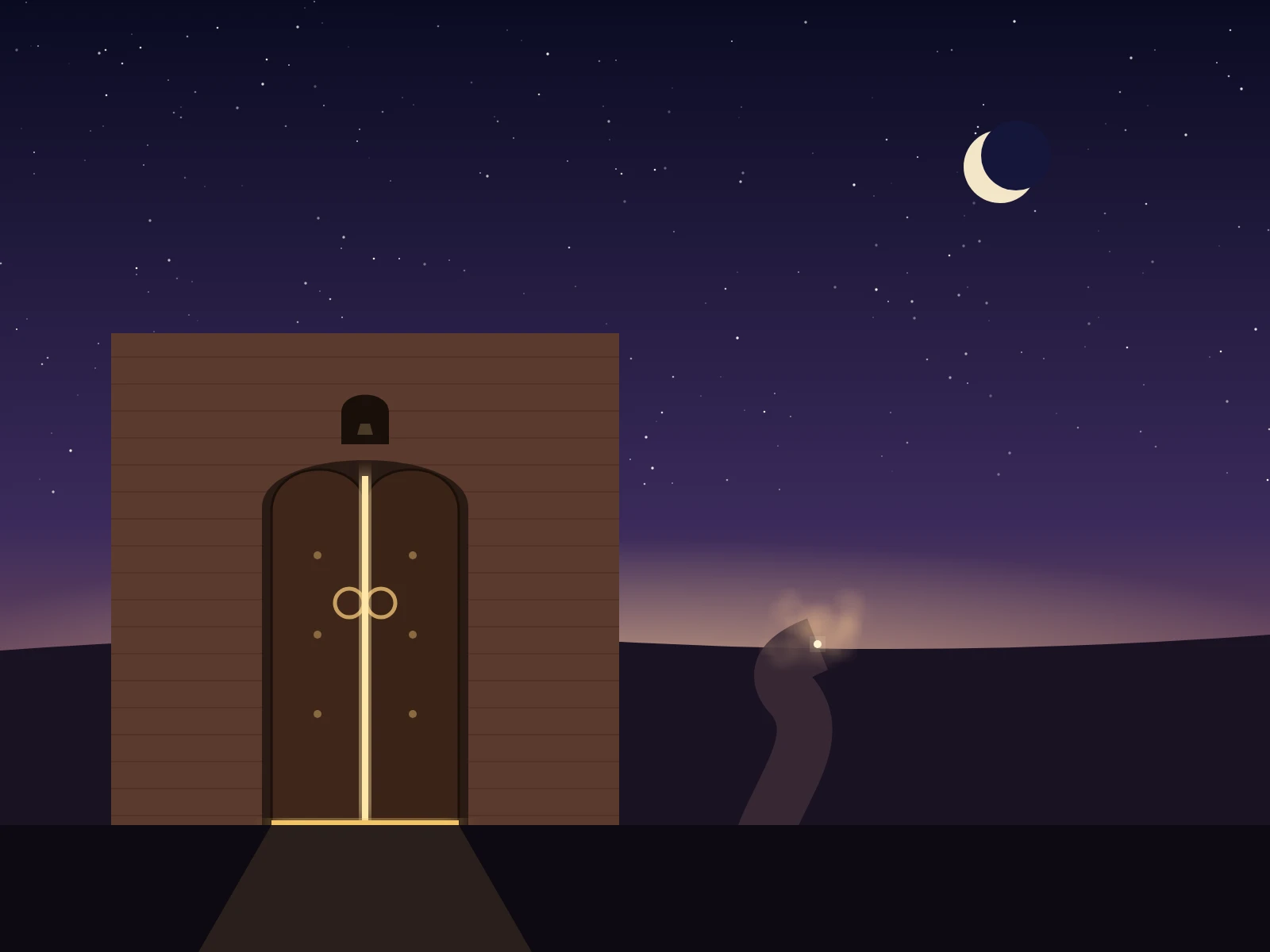
No One Knocks
در این سرای بیکسی کسی به در نمیزند
به دشت پرملال ما پرنده پر نمیزندIn this house of loneliness, no one knocks at the door;
over our sorrowful plain, not a single bird takes wing.
Sayeh, one of the great masters of the modern Persian ghazal, captures the ache of waiting and isolation: a closed house, an empty plain, a road that carries only dust without a rider. Yet in the image, light glows from behind the closed door. In the language of Erfan, the one we wait for outside may already be within; loneliness can become a call to open the inner door. And for us today, it is a gentle reminder: somewhere, someone is waiting for a knock. Be that knock.
Only the opening couplet is quoted here; the full ghazal remains the copyrighted work of the poet’s estate.
Timeless wisdom
Not bound to time, but to our deepest inner self
These poems were written seven or eight centuries ago, yet they describe our lives with surprising accuracy. That is because they are not really about their century. They are about the human heart, which has not changed: its longing, its fears, its hope and its search for meaning. Here is how each poem on this page speaks to the world we live in now.
The Song of the Reed · Rumi
Millions of people today live far from the place they were born: immigrants, refugees, children of the diaspora. The reed’s cry of separation is their story too. But Rumi goes deeper: even at home, many feel cut off from something essential. The longing itself is a compass pointing back to our origin.
“Love seemed easy at first” · Hafez
Every meaningful commitment, a marriage, a new business, a move to a new country, a career change, begins with excitement and then meets difficulty. Hafez reminds us that difficulty is not a sign we chose wrong; it is part of every path worth walking.
“Lost Joseph will return” · Hafez
For anyone facing job loss, illness, displacement or grief, this is a timeless message of hope. The house of sorrow can become a rose garden. Resilience is not denial; it is trust that the story is not finished.
“The children of Adam” · Saadi
Pandemics, climate change and global markets have shown how deeply connected humanity is. When one part of the world suffers, the rest cannot stay at ease. Saadi said it eight centuries ago.
“The Cup of Jamshid” · Hafez
We search online, in courses and in other people’s opinions for answers we already carry within. Hafez’s cup is the reminder to look inward first.
The Simorgh · Attar
Teams, communities and nations often wait for a perfect leader or saviour. Attar’s thirty birds discover that what they sought was themselves, together. Real change begins when we see our own role.
The Pale Blue Dot · Carl Sagan
A modern scientist reaches the same humility as the mystics: from far enough away, our borders disappear, and kindness becomes the only sensible response.
Read them slowly. Read them aloud. They were written for that quiet place inside each of us, the place no century can reach.
More to come
I will keep adding favourite verses, reflections on Erfan and readings of Ferdowsi, Khayyam, Attar, Sohrab Sepehri and other poets. If there is a poem you would like me to write about, send me a note.